%20compressed.jpg)
A U.S. soldier loads a Raytheon Coyote counter-unmanned aircraft system (C-UAS) interceptor into a launch module. [PUBLIC DOMAIN]
By Stephen Borgna
Marketing Communications Specialist
Modern combat environments are making a new reality very apparent. Major conflicts throughout the 2020s have made it clear there exists a demand for both high-end precision weapons and lower-cost systems that can be produced, integrated, and deployed at greater scale.
There will always be a demand for hyper-advanced precision weapons within modern arsenals, particularly for targeting hardened infrastructure, command centers, large ships, air-defense sites, and other high-value targets with a single strike. Operation Epic Fury and the Russia-Ukraine War have demonstrated, however, that high-demand precision weapons — which can take years to develop — can be consumed fast across strike, air defense, and counter-UAS missions. For example, it's estimated that the U.S. may have expended a significant share of its Terminal High Altitude Area Defense (THAAD) interceptors and other inventory during recent operations against Iran, underscoring how quickly high-end defensive munitions can be consumed in a major missile-defense campaign.
The industry is responding. A wide range of lower-cost programs are currently being developed to supplement premium precision weapon systems. The idea is to utilize premium systems for the most demanding missions while complementing them with lower-cost, modular, and COTS-enabled munitions designed for affordable mass. Programs such as Barracuda, LUCAS, LCCM, FAMM, ERAM, APKWS, Roadrunner, and Coyote are all part of the push to develop systems that are both capable and scalable.
The Shift Toward Affordable-Mass Munitions
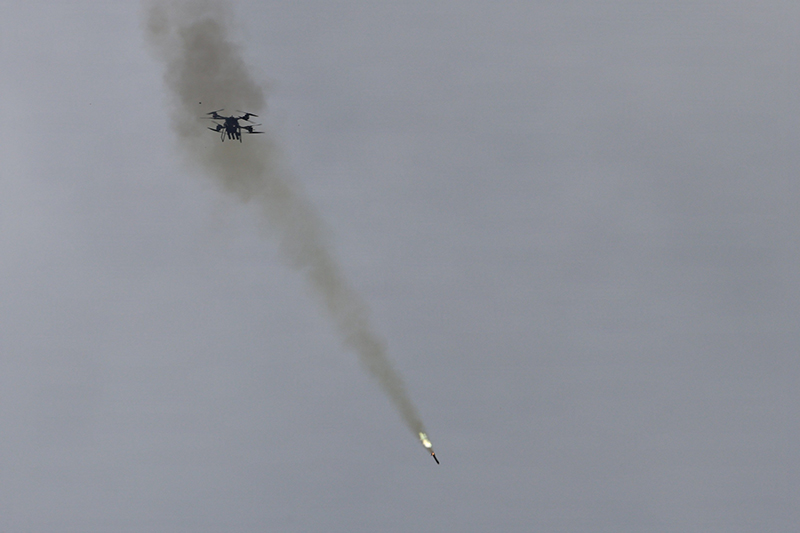
A TRV-150 tactical resupply drone fires a 70mm Advanced Precision Kill Weapon System (APKWS) rocket during flight testing at Fort Rucker, AL, on May 20, 2026. BAE Systems’ APKWS is a laser-guidance kit that converts an unguided 2.75-inch / 70mm Hydra rocket into a precision-guided munition. [PUBLIC DOMAIN]
The gradual move toward affordable mass, defined as the strategy of adopting high-volume, cost-effective munitions and autonomous drones to complement existing high-end weapons systems, has been building for years now.
But as Operation Epic Fury has wound down, the need for this strategy has been made clearer than ever. Replenishing stocks of key weapons systems used during the war are expected to take years to complete, a testament to these systems’ effectiveness and capabilities.
The move toward affordable mass does not mean militaries will abandon these high-end precision weapons. Tried-and-true systems such as Tomahawk, JASSM, Patriot, THAAD, and other advanced munitions are still the first option for missions that require long-range flight, survivability, complex guidance, and high confidence against difficult targets. These systems deliver capabilities that lower-cost weapons are not designed to replace.
But defense and industry leaders have identified that there needs to be a broader mix. Modern combat operations can require large numbers of effects across dispersed targets, drone swarms, air defense threats, maritime environments, and time-sensitive strike missions.
You may not need a Tomahawk or Patriot missile for some of these types of missions. A cheaper option that can deliver useful effects at lower cost, with simpler system architecture and more scalable production models, may be more than sufficient to get the job done. These include low-cost cruise missiles, one-way attack drones, modular counter-UAS interceptors, and containerized or palletized weapons designed for flexible deployment.
Existing assets can also be retrofitted where appropriate through guided rocket kits and other systems. BAE Systems' APKWS kit for instance is designed to transform an unguided Hydra rocket into a precision munition. Hydra rockets, which are often used by helicopters such as the AH-64 Apache and AH-1 Cobra, are often cited as costing a few thousand dollars per round, while APKWS-equipped rockets are commonly reported at roughly $25,000 to $40,000 per shot, depending on configuration and what is included in the estimate.
Next-Generation Low-Cost Cruise Missiles
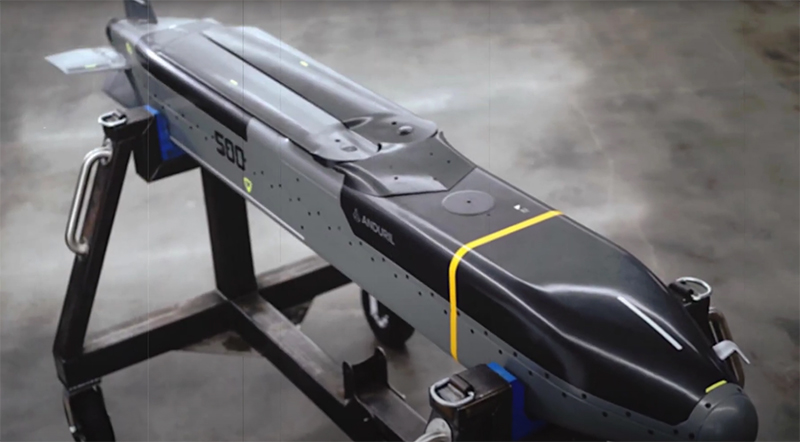
An Anduril Barracuda-500M Cruise Missile. [PUBLIC DOMAIN]
The American military branches are well into the process of spurring development from industry of affordable mass munitions and laying out acquisition strategies.
The U.S. Air Force, for instance, has put forth a procurement plan known as its Family of Affordable Mass Munitions (FAMM) program. This program intends to allocate approximately $12 billion over the next five years to acquire nearly 28,000 low-cost munitions.
The Pentagon also has its own overarching acquisition effort through its Low-Cost Containerized Missile / Munition (LCCM) program. This program lays out plans to procure a minimum of 10,000 low-cost cruise missiles over the next three years, and reportedly “fits within” the Air Force’s FAMM goals. Multiple industry producers, including Anduril, Leidos, and Zone 5 Technologies, are involved in efforts to develop new platforms that will stock these programs.
One platform in particular that’s received a lot of buzz is Anduril’s Barracuda-500M. The Barracuda is a low-cost cruise missile reportedly expected to cost a few hundred thousand dollars per unit — significantly less expensive than some of the premier munitions in U.S. and allied arsenals.
Compared to the subsonic Tomahawk cruise missile that serves as the U.S.’ primary long-range precision strike asset, the Barracuda is a lower-cost autonomous air vehicle (AAV) and cruise missile designed to complement Tomahawk’s long-range strike capabilities. Barracuda is also air breathing, which means it utilizes a turbojet air-breathing engine that consumes atmospheric oxygen for combustion during flight instead of carrying heavy on-board oxidizers.
According to public reporting, Barracuda has a range of approximately 500 nautical miles compared to the Tomahawk's 1,000-plus-mile class range while carrying a lighter warhead. But Barracuda's true advantage is its simplified assembly process, fewer parts, fewer tools needed to manufacture it, reusable subsystems, and commercial supply chain. A Barracuda missile is purported to take 50 percent less time to produce while using 95 percent fewer tools and 50 percent fewer parts than similar systems.
One-Way Attack Drones and Low-Cost Autonomous Strike Platforms
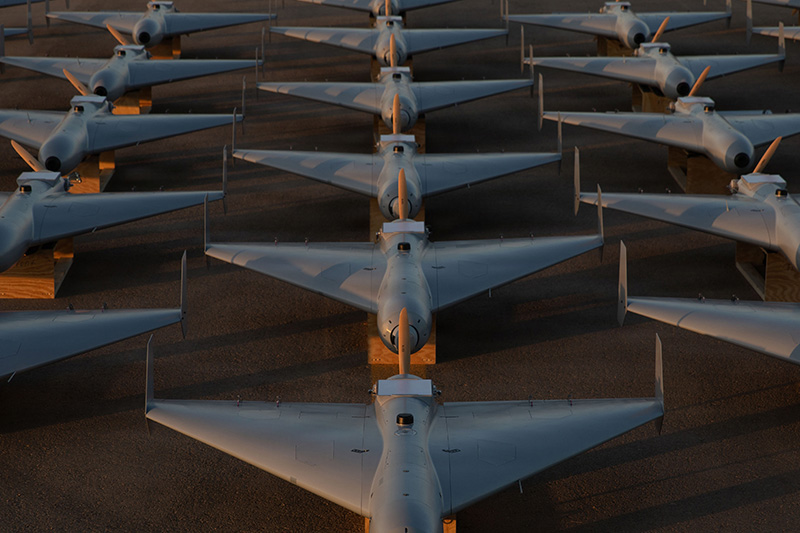
A fleet of U.S. LUCAS drones sitting idle on wooden blocks. [PUBLIC DOMAIN]
Alongside low-cost cruise missiles, one-way attack drones have become another prominent category in the push toward affordable mass. These types of systems are typically smaller, less complex, and less expensive than traditional cruise missiles, but they can still deliver powerful effects across long distances when matched to the right target set and mission parameters.
One example is the Low-Cost Uncrewed Combat Attack System, or LUCAS. Developed by Spektre Works, LUCAS is a U.S. one-way attack drone for long-range, low-cost strike missions. CENTCOM has described LUCAS as costing approximately $35,000 per platform, making it significantly less expensive than many traditional precision munitions and cruise missiles. The U.S. reportedly utilized LUCAS drones for the first time during Operation Epic Fury.
LUCAS was developed upon observing the widespread use of Iranian Shahed-style drones throughout years of the Russia-Ukraine War, and, most recently, Operation Epic Fury. What became unavoidably clear was how inexpensive one-way systems can significantly stress a more sophisticated force when deployed in swarms at scale.
Public reporting describes the FLM-136 LUCAS as having a range of approximately 500 miles and a maximum payload of around 40 pounds. That payload is much lighter than a cruise missile such as Tomahawk (publicly reported to carry a 1,000-pound warhead), and, like Barracuda, LUCAS is not intended to replace high-end strike weapons.
Instead, it provides American forces another option: overwhelming defenses with swarms that can’t be defeated in time before the intended target is hit. When it comes to drone swarms, only one or a few must break through.
Premium munitions will remain indispensable for hardened, defended, or high-value targets, but low-cost autonomous drones like LUCAS can help expand strike capacity against softer, distributed, or time-sensitive targets. This is why LUCAS and other low-cost autonomous platforms such as Raytheon’s Coyote C-UAS system are in the same affordable-mass conversation as Barracuda and other emerging low-cost strike systems.
COTS-Enabled System Architectures
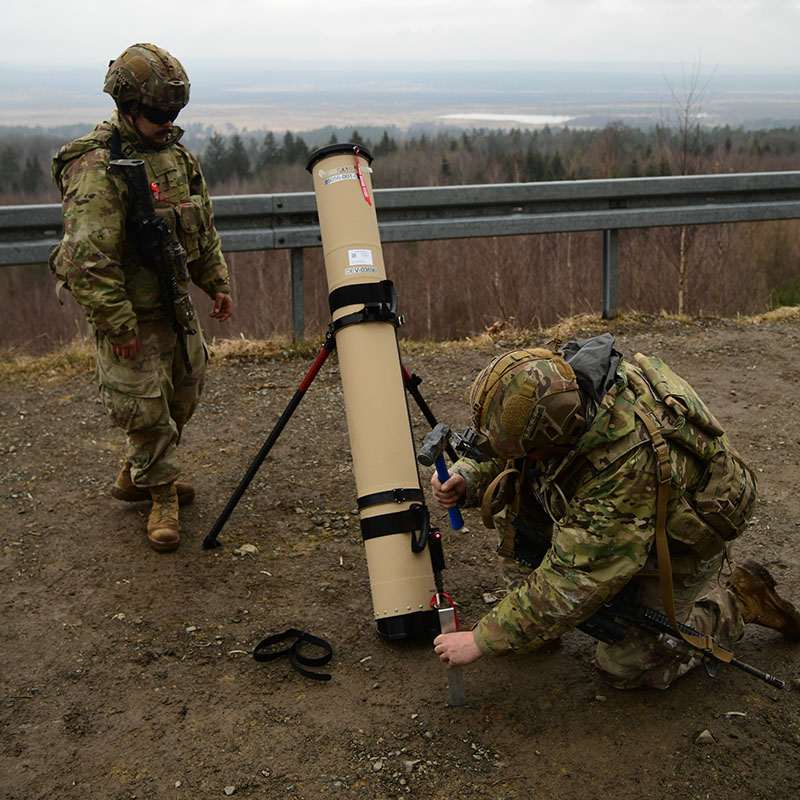
U.S. Soldiers assigned to 3rd Brigade, 10th Mountain Division set up a Switchblade 600, a Low Altitude Stalking and Striking Ordnance weapons system during a live fire exercise at the 7th Army Training Command's Grafenwoehr Training Area, Germany, Feb. 25, 2025. While Switchblade is a purpose-built military loitering munition, systems in this class reflect the broader COTS-enabled trend toward compact electronics, modular payloads, software-defined control, and scalable autonomous strike architectures. [PUBLIC DOMAIN]
Commercial-Off-The-Shelf (COTS) components and systems are one of the major drivers of these low-cost munition programs. Rather than relying exclusively on tailored and proprietary components, many of these systems are being designed to incorporate COTS parts, commercially available electronics, simplified propulsion systems, and more common manufacturing inputs where applicable.
This is part of what makes platforms like Barracuda and LUCAS such a significant shift in the philosophy of munitions production. Yes, they are cheaper than a Tomahawk or other premier strike weapon, while retaining a percentage of those weapons’ effectiveness. But more importantly, they’re being designed around commercial supply chains, lower parts counts, reusable subsystems, and simplified assembly from the beginning.
Of course, COTS-enabled does not mean commercial-grade hardware is simply dropped into a munition and called good enough. These systems still must withstand vibration, shock, temperature extremes, storage, transport, and launch conditions typically encountered when operating in harsh environments. The value is in using available commercial technologies where they make sense, then ruggedizing and integrating them into defense-grade architecture.
For interconnect systems, this is where the design challenge becomes important. Low-cost munitions and autonomous platforms still need reliable power, signal, data, payload, launch-control, and test connections. But those connections also need to support the broader goal of making the system easier to assemble, configure, inspect, and deploy at scale.
Modular Payloads and Mission Electronics
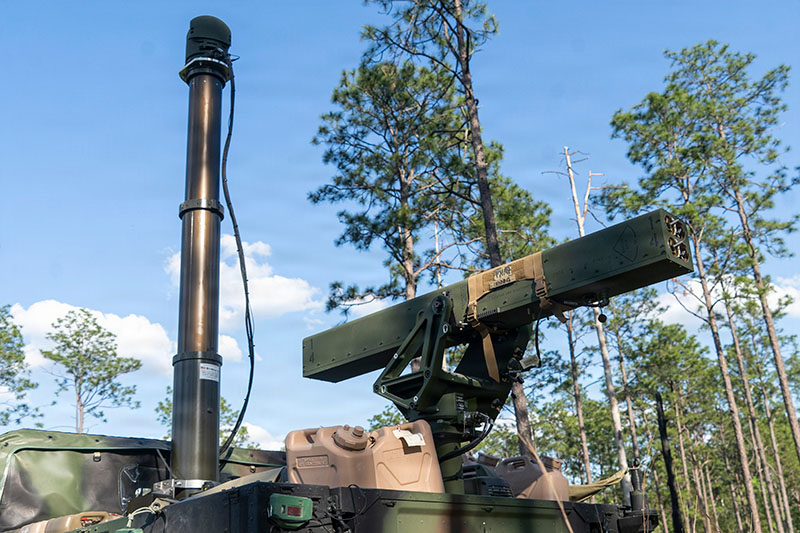
A Vehicle-Agnostic Modular Palletized ISR Rocket Equipment (VAMPIRE) system, assigned to Alpha Battery, 3rd Battalion, 320th Field Artillery Regiment, 3rd Mobile Brigade, 101st Airborne Division (Air Assault), is positioned for tactical employment on April 8, 2026 during a Joint Readiness Training Center rotation at Fort Polk, Louisiana. The VAMPIRE is a modular, multi-role weapon system designed to counter Group 2 and 3 unmanned aircraft systems and provide ground-based security in contested environments. [PUBLIC DOMAIN]
The other major trend across these systems is modularity. Next-generation munitions are increasingly being designed to accommodate different seekers, sensors, payloads, guidance kits, datalinks, and test interfaces depending on the mission.
This is important because not every target requires the same effect. A low-cost cruise missile may need one payload for a softer target set and a different configuration for more complex mission parameters. A one-way attack drone may need different navigation, communications, or payload options depending on range, environment, and intended target. A counter-UAS system such as Coyote or an APKWS-equipped rocket may require different sensing, guidance, or launch integration depending on how it is deployed.
APKWS is one of the clearest examples of this. Instead of developing a completely new weapon from scratch, BAE Systems’ guidance kit converts an existing unguided 70mm Hydra rocket into a precision-guided munition. This is the affordable-mass philosophy in a nutshell: take a readily available, cheap munition, add the mission electronics needed to improve it, and field it across a wide range of platforms.
The same broader idea applies across other newer programs like Barracuda, LUCAS, LCCM, and other autonomous offensive platforms. Their value is tied not only to the airframe, but to the ability to configure the system around different mission electronics, payloads, launch methods, and support equipment.
Interconnect Systems for Affordable-Mass Munitions
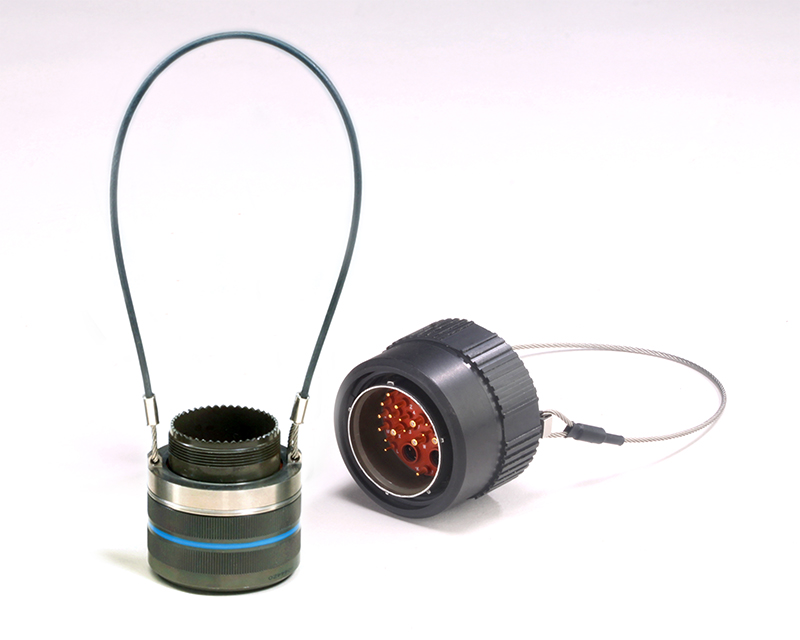
Amphenol Aerospace D38999 Series III Breakaway Fail-Safe Connectors are ideal for weapons release applications.
Amphenol Aerospace offers interconnect systems designed for the connection, disconnection, and release requirements that will be needed for this new generation of affordable mass munitions. Modularity, launch-flexibility, and COTS-enabled system architectures will all be key features baked into the design of these platforms, and their connectors must do more than maintain electrical continuity. They also must support fast assembly, reliable testing, secure retention, and, in some applications, clean separation at the moment of deployment. Amphenol’s push-pull and lanyard release connectors are already tailor-made and ready to perform these exact tasks.
MIL-DTL-38999 Breakaway Lanyard Connectors
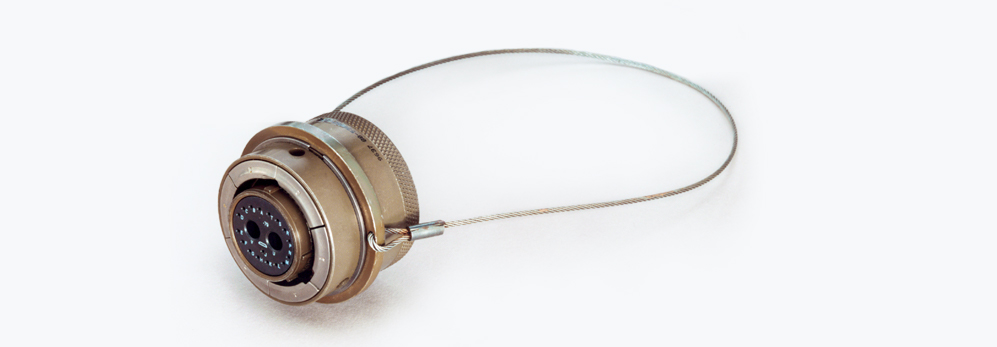
Amphenol Series I LJT breakaway connectors are designed for instant disengagement in harsh environments.
In munition and weapons-release applications, disconnection is not always a maintenance step. Sometimes it is part of the mission sequence itself. A connector may need to remain securely mated through handling, transport, aircraft carriage, vibration, and environmental exposure, then separate quickly and predictably when the system is released.
Amphenol’s MIL-DTL-38999 breakaway lanyard connectors are designed for those fail-safe quick-disconnect requirements. The D38999 Series III Breakaway Fail-Safe family includes D38999/29, /30, /31, and MIL-STD-1760 Type II-qualified configurations for weapons-release applications, while Series I LJT Breakaway connectors provide instant disengagement in rugged environments. These connectors support axial-pull lanyard release, allowing the plug and receptacle to decouple cleanly when the lanyard is actuated.
2M804 Push-Pull Quick-Disconnect Connectors
.png)
With up to 85 signals, panel-mounting options, and customizable separation forces, 2M804 Push-Pull Quick-Disconnect Microminiature Connectors are an extremely versatile and reliable push-pull interconnect for harsh environments.
Not every connection in a modular munition or launch system needs a lanyard release. Many interfaces need something slightly different: fast, secure mating in a compact package that can withstand rugged defense environments while supporting repeated assembly, inspection, configuration, and testing.
Amphenol’s 2M804 push-pull quick-disconnect connectors are built for those applications. With a push-to-connect interface, the 2M804 series brings the performance and reliability associated with Amphenol’s 2M micro-miniature connector family into a push-pull format designed for quick connection and disconnection. They are waterproof, dustproof, highly resistant to EMI interference, and suited for rugged applications where space and weight are limited.
WaSP Connector
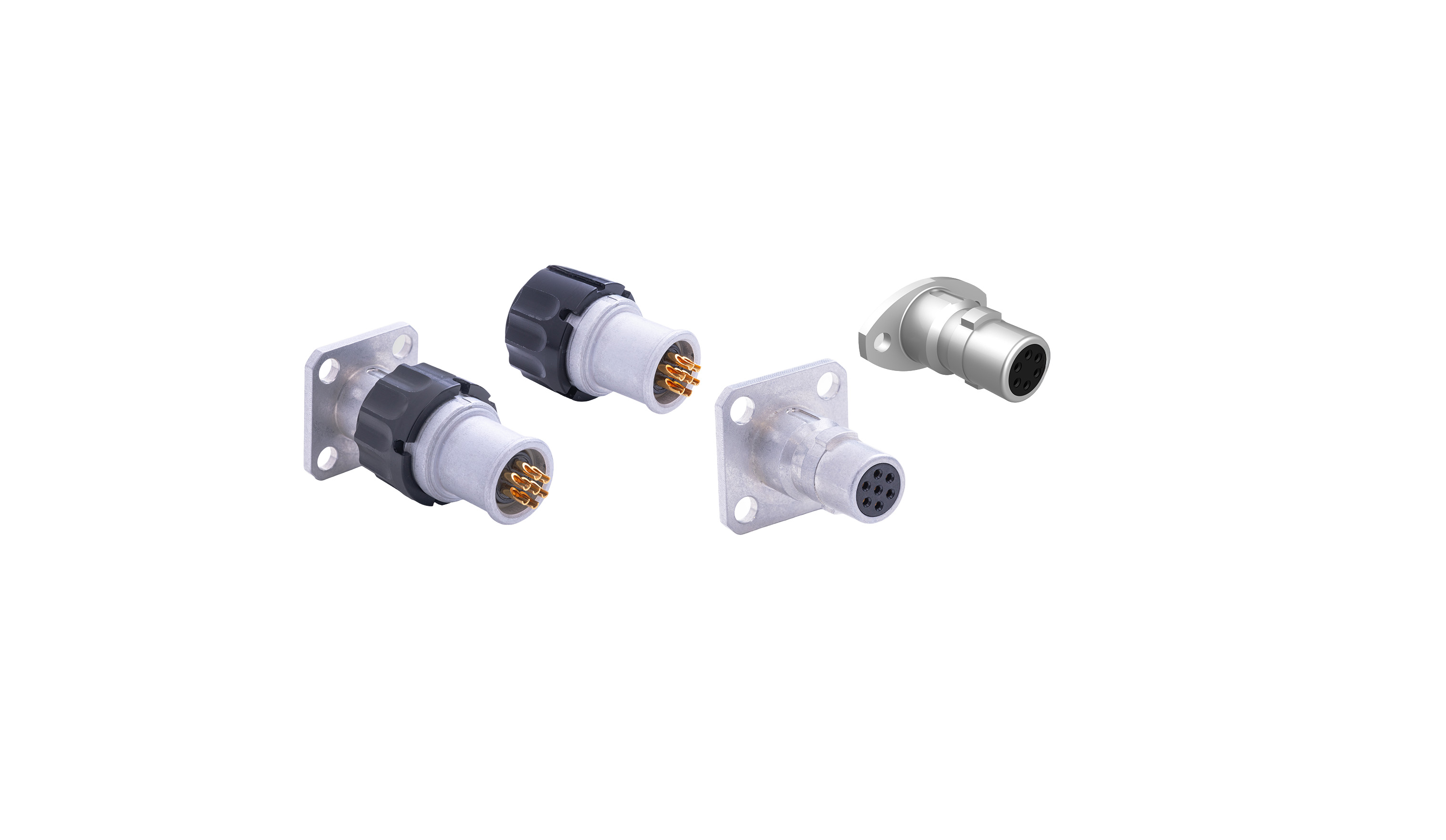
WaSP is a size, weight, power, and cost (SWaP-C) -optimized connector ideal for high-volume harsh-environment applications such as low-cost drones and munitions.
Amphenol Aerospace’s WaSP connector is a durable, lightweight, low-cost microminiature circular connector designed for high-volume harsh-environment applications where size, weight, power, and cost are major design drivers. Based on the TERRAPIN SCE2 series, WaSP features a simplified interface for quick mating, a lightweight aluminum shell, a 1/4-turn polymer locking ring, IP67 sealing in mated and unmated conditions, and a passivation anti-corrosion layer. With compact 7-way configurations, 5A current rating on 25 AWG contacts, and operating performance from -55°C to +85°C, WaSP is well suited for UAVs, drone swarm technologies, UGVs, communications systems, and other smaller platforms that need rugged connectivity without unnecessary weight, complexity, or cost.
Visit Amphenol Aerospace’s Lanyard Release/Quick Disconnect and 2M Microminiature pages for more information.