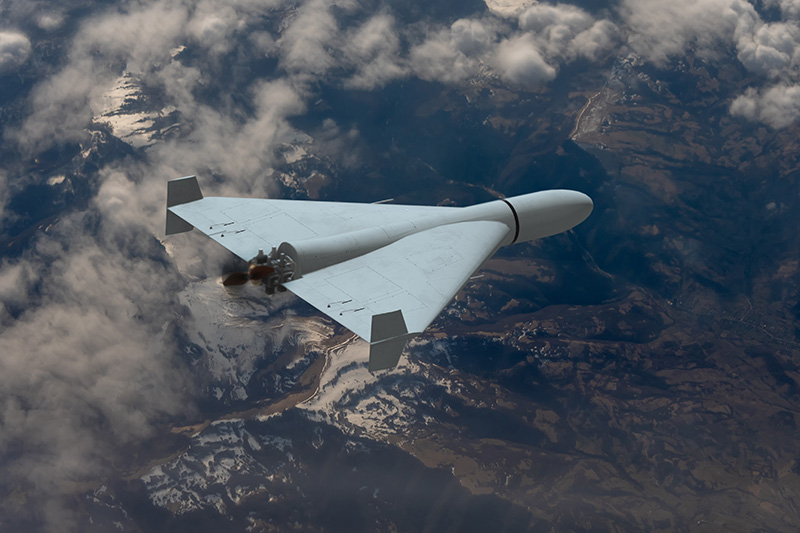
The evolving capabilities of small, cheap, yet effective drone technologies such as FPV drones, one-way attack drones, and drone swarms are placing greater demands on the abilities, and interconnect needs, of the anti-drone counter-UAS platform.
By Stephen Borgna
Marketing Communications Specialist
Small and medium-sized unmanned aerial systems (UAS) have advanced greatly over the last decade or so. Once considered more of a niche threat, small, cheap, yet increasingly effective drones such as first-person view (FPV) drones, one-way-attack drones (commonly known as suicide drones or kamikaze drones), and drone swarm technologies have become a persistent operational challenge across military, security, and critical-infrastructure environments. Low-cost platforms, autonomous flight modes, and coordinated drone swarm tactics have reduced the cost-efficiency of traditional air defenses, forcing counter-UAS (C-UAS) systems to evolve rapidly. Today’s anti-drone solutions must detect, classify, and neutralize targets in heavy electromagnetic environments, often with little warning and under strict mobility and deployment constraints.
It wasn’t always like this. Before the C-UAS mission evolved, this class of drones was typically considered a traditional air defense threat that could be primarily defeated with existing air defense or electronic warfare (EW) capabilities, at a time when drones had not yet emerged as a threat demanding more specialized responses.
If those systems weren’t available, warfighters would typically fall back to more immediate countermeasures such as handheld C-UAS systems (i.e. drone guns), man-portable air-defense systems (MANPADS), or small arms. As demonstrated repeatedly by recent conflicts such as the Russia-Ukraine War, particularly in the early days of hostilities, these types of countermeasures are not entirely adequate due to system limitations and the significant cost-imbalance of deploying traditional air defenses against simple attack drones that may cost just a few thousand dollars each. Supply chains of advanced, expensive air defense systems such as surface-to-air missiles (SAM) may not be able to sustain the pace of demand over time if the onus of drone defense falls on them alone.
In many ways, the drone revolution mirrors earlier inflection points in military technology. The Maxim machine gun developed in the late 19th century was a massively disruptive technology, allowing a smaller force to go toe-to-toe with larger ones and even overwhelm them. The British Chain Home radar network developed by Scottish radio engineer Robert Watson-Watt and brought online in 1938 was the world’s first operational radar system. This radical innovation of the time revolutionized air defense and stripped the tactical edge from advanced long-range aircraft of the era, as air forces could no longer rely on the element of surprise alone.
Countermeasures have historically followed disruptive military innovations. EW and stealth technology emerged to counter and defeat radar-embedded air defenses. Decades earlier, armored vehicles such as tanks followed by modern infantry doctrine that emphasized small-unit and fire-and-maneuver tactics were developed to overcome the dominance of weapons like the Maxim. Similarly, C-UAS aims to address the significant vulnerability created by the maturation and proliferation of low-cost offensive drone technologies.
The modern C-UAS system is evolving to become much more distributed, data-intensive, and power-dense. Sensor fusion, edge processing, EW, and directed energy weapon (DEW) technologies all place significant demands on these systems. High-speed data movement, reliable power delivery, electromagnetic interference (EMI) resilience, and modular system design directly influence the performance, scalability, and lifecycle cost of C-UAS architectures.
Today, multiple C-UAS systems and protection networks have since come online or are in the pipeline that demonstrates the complexity of the modern C-UAS suite.
Mobile Counter-UAS
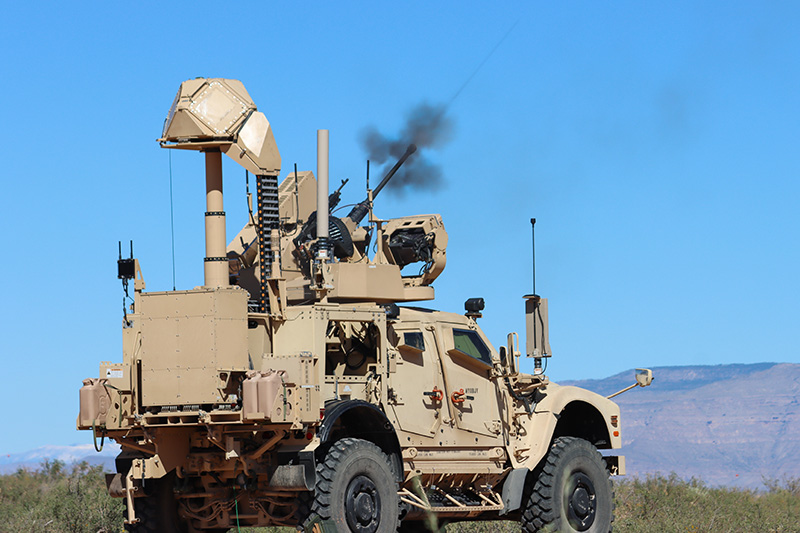
A Mobile-Low, Slow, Small Unmanned Aerial Vehicle Integrated Defeat System (M-LIDS) during a training exercise. [U.S. Army]
Mobile platforms are one of the fastest growing areas of C-UAS technology. As assets maneuver around a contested area, modern battlefield trends indicate they may now be up against a large swarm of inexpensive attack drones capable of dealing significant damage to a much larger and advanced force. Assets exposed to the threat of drone swarms must be able to counter them quickly and efficiently.
Mobile C-UAS platforms can take the form of many systems. Systems such as the U.S. Army’s Mobile–Low, Slow, Small Unmanned Aircraft Integrated Defeat System (M-LIDS) show how C-UAS capabilities are evolving into fully integrated, vehicle-mounted systems rather than traditional air defense systems and soldier-carried equipment.
M-LIDS is a full-spectrum C-UAS suite mounted on an armored vehicle such as the Joint Light Tactical Vehicle (JLTV) or a Mine-Resistant Ambush Protected (MRAP) vehicle. It features an EW system as well as a variety of sensors, radars, cameras, and weapons to identify and eliminate drone threats quickly. The system is intended for use with the U.S. Army.
Systems like M-LIDS don’t rely on a single detection or defeat mechanism. Ideally, they combine radar, electro-optical/infrared sensing, radio frequency (RF) detection, electronic and sometimes kinetic defense into a mobile, layered system designed to effectively spot, track, and take down drones before they pose a significant threat.
Vehicle-integrated, modular C-UAS architectures like M-LIDS require significant bumps in internal data flow, power distribution, and electromagnetic complexity, particularly within tactical vehicles constrained by size, weight, and power (SWaP) requirements.
Electronic Warfare Counter-Drone Platforms
_Stryker.jpg)
EW remains one of the most widely deployed and adaptable counter-drone approaches because it can deliver a rapid, repeatable effect without requiring a kinetic response such as from SAMs or autocannons. As drone threats become more autonomous, more frequency-agile, and increasingly capable of operating with reduced operator input, EW systems have had to evolve beyond basic “drone jammers” into more deliberate, integrated platforms designed to detect, identify, and disrupt the signals that enable UAS to communicate, navigate, and execute their objective. In many environments, EW also offers a lower-collateral option for engagement, particularly when the priority is denial, disruption, or forcing a drone to abort rather than physically destroying it.
EW C-UAS systems can take the form of fixed-site systems protecting critical infrastructure, vehicle-mounted systems supporting forces on the ground, and distributed architecture across a defended area. Regardless of form factor, the most capable EW systems are increasingly paired with RF sensing and direction-finding capabilities to classify signals of interest before applying an effect.
This is a key shift. Rather than transmitting broad spectrum jamming indiscriminately, modern EW C-UAS platforms aim for faster identification, tighter targeting, and improved control of electromagnetic impact in crowded electromagnetic environments.
EW is increasingly expected to integrate cleanly with radar, EO/IR, and command-and-control nodes as C-UAS deployments continue trending toward layered architectures and multi-sensor fusion. That integration places added demands on internal data transport, latency, and signal integrity, especially in SWaP-constrained mobile platforms and dense fixed-site installations.
Directed Energy Weapon Counter-UAS
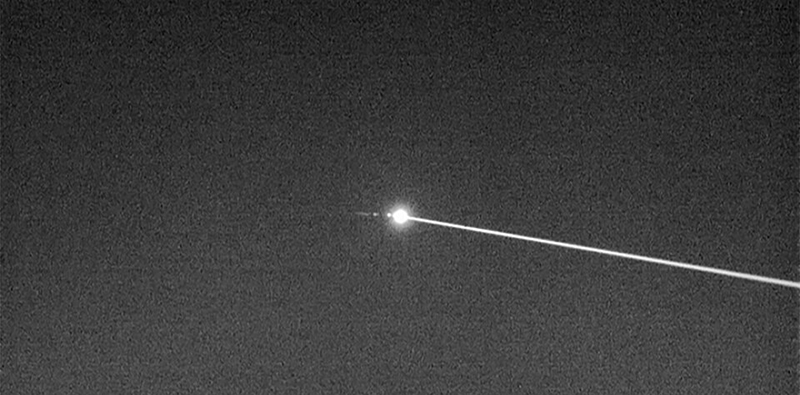
A High Energy Laser weapon engages a drone at White Sands Missile Range in April 2022.
DEWs are one of the fastest maturing technologies within C-UAS. DEW technologies can engage targets rapidly at only a few dollars per shot, which is an ideal solution for engaging low-cost drone threats that can be deployed numerously and promptly. Rather than relying on interceptors or other expendable munitions, a DEW system aims to disable drones by delivering concentrated electromagnetic energy, most commonly through high-energy lasers (HEL) or high-power microwave (HPM) systems. These systems could significantly alleviate the constant production and resupply burden associated with more traditional air defenses.
DEW C-UAS platforms can be deployed in a variety of different profiles. This includes fixed-site installations for base defense, as well as shipboard systems and vehicle-mounted systems. HEL systems generally focus on precision destruction of individual targets through thermal damage to key components, while HPM systems can disrupt electronics across a wider area or against multiple targets.
Multiple DEW systems are currently under development and are being field tested due to the immense operational potential they could bring, such as the U.S. Navy’s High Energy Laser with Integrated Optical-dazzler and Surveillance (HELIOS). Capable of scaling its fiber laser weapon output between 60–120 kW and potentially up to 150 kW through its modular power and fiber-optic architecture, the HELIOS system has begun integration with the Aegis Combat System on the Navy’s Arleigh Burke-class destroyers. Broader plans call for integrating it across the fleet for use not only against drones, but also against small boats and potentially cruise and anti-ship missiles.
At the subsystem level, DEW systems impose some of the most demanding integration requirements in the C-UAS ecosystem. They require high power generation, conditioning, and distribution; stable thermal management to sustain output; and tightly controlled timing and pointing to achieve consistent effects on target. Even in cases where the “weapon” draws the spotlight, the supporting architecture such as power electronics, cooling, beam control, and safety interlocks often defines what the system can do in real-world conditions. For mobile DEW platforms, these demands become even more challenging due to SWaP constraints, limited cooling capacity, and vehicle power budgets.
Critical Infrastructure Protection Against Drones
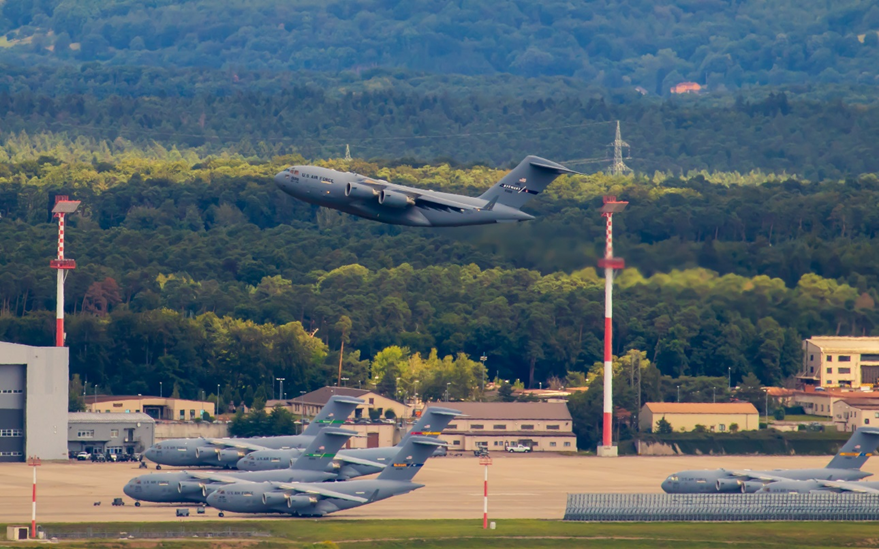
As the threat of drones increases, it’s become apparent that these systems can pose a serious risk to critical fixed installations. Military installations and airfields as well as government sites, civilian airports, energy facilities, ports, and major public venues are increasingly evaluating counter-drone capabilities as part of broader physical security planning. Unlike deployments in the field, these sites likely prioritize persistent coverage, predictable performance, and clear operational control, often in environments where safety, regulatory considerations, and collateral risk are front-and-center.
Fixed-site C-UAS systems can take many forms, but the most effective architectures are typically layered. They combine wide-area detection, often radar and RF sensing, with identification and tracking via electro-optical/infrared cameras, then pair those inputs with a controlled response option. In many cases, the “response” is designed around managed effects and escalation, which can include electronic attack, coordination with security forces, or cueing to other defeat mechanisms depending on the site’s risk posture and rules of engagement.
Fixed-site deployments also have unique electromagnetic and networking challenges that other C-UAS missions may not have to deal with. Critical infrastructure environments can be electrically noisy, physically expansive, and already saturated with communications systems. As C-UAS solutions become more distributed by placing sensors on rooftops, towers, or perimeter locations, the architecture must support significant data transfer, synchronization, and electromagnetic compatibility across the site. Integration with existing security networks and operational centers further increases the demand for clean interfaces, predictable latency, and scalable internal bandwidth.
These are just some of the applications where C-UAS technology is evolving to meet the new realities presented by drone threats, and they all have unique capabilities and operational challenges.
Interconnect Solutions for Modern UAS and Counter-UAS Systems
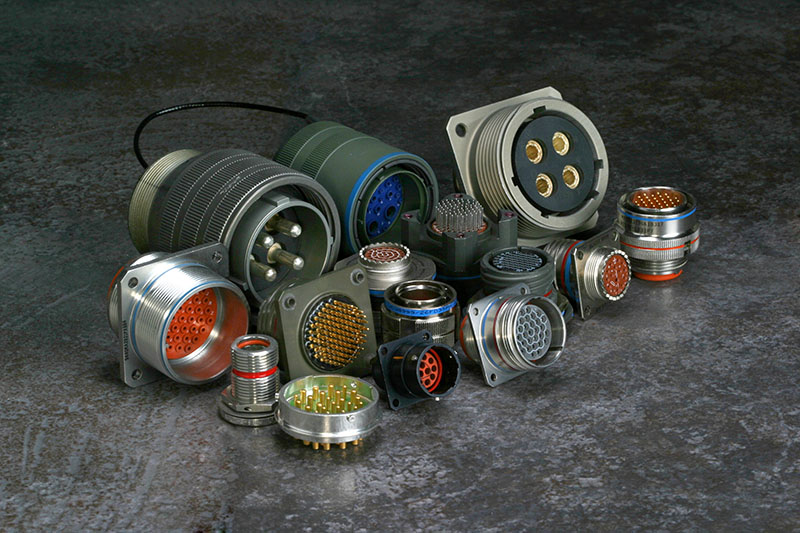
Amphenol Aerospace offers a broad catalog of interconnect solutions that can be tailored to address the rising interconnect challenges on the rapidly evolving system architectures of C-UAS platforms across both signal and power requirements.
WaSP Microminiature Connectors
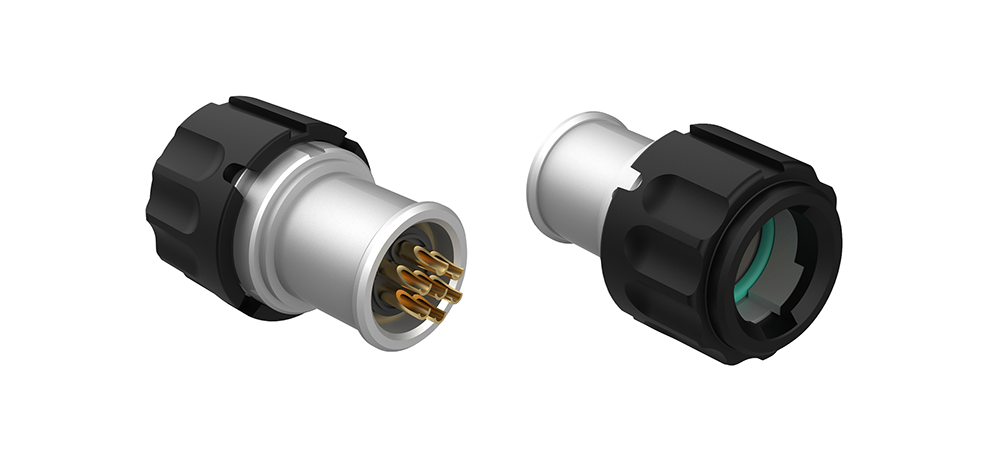
Amphenol Aerospace’s new WaSP connector series is the ideal high-volume, SWaP-C-optimized microminiature solution for UAS and counter-UAS systems and is the latest entry to our microminiature solutions catalog. Extremely light and low-profile, with an aluminum shell plug and receptacle weighing just over nine grams mated, WaSP delivers 400V AC working voltage and supports 25 AWG contacts rated to carry up to 5 amps of DC current, depending on ambient temperature.
WaSP features strong environmental performance with IP67 sealing and is rated for 48 hours of salt spray with a passivation layer and an operating temperature range of -55°C (-67°F) to 85°C (185°F). Mating the WaSP is quick and simple with a ¼ turn polymer locking ring and no jam nut.
UAS and C-UAS technologies are rapidly trending toward system architectures that can be produced cheaply and quickly, but interconnect performance must remain reliable while delivering the rugged resilience expected of harsh environment systems. WaSP has been engineered to fill this niche.
VITA Connectors
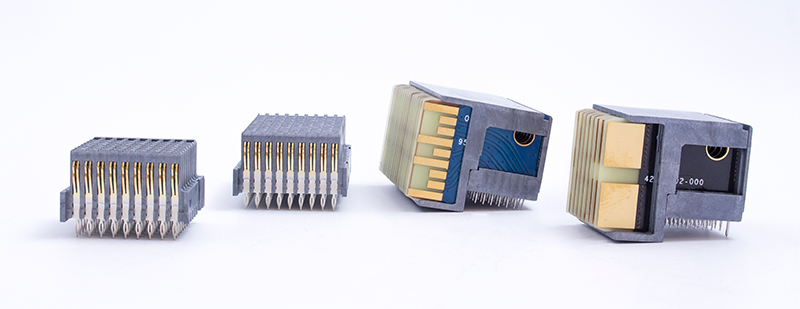
Spanning a variety of VITA open standards including VITA 46, VITA 46.30, VITA 62, VITA 66, and VITA 91, Amphenol Aerospace VITA Connectors are the ideal board-to-board interconnect for electromagnetically complex, rapidly evolving C-UAS platforms.
Our VITA portfolio supports multi-gigabit data rates (including up to 56 Gb/s PAM 4 speeds for MIL-HD2), high signal density with up to 140 signals per inch, and compatibility with a variety of high-speed protocols such as PCIe (Gen 1-5), Serial RapidIO, and Gigabit Ethernet.
Just as importantly, our VITA portfolio is engineered for rugged embedded environments with robust contact systems, low mating force designs, and intermateability with existing VITA 46 solutions. This allows C-UAS platforms to upgrade processing, add RF or optical modules, and scale capability without redesigning the full system.
Fiber Optic Connectors
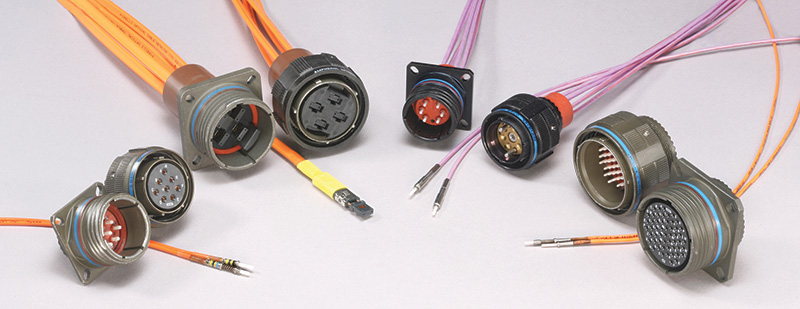
Amphenol Aerospace’s Fiber Optic Interconnect portfolio, built around our proven MIL-DTL-38999 Series III platform, enables reliable fiber data links throughout C-UAS architecture while preserving the ruggedization required for harsh environments.
Our fiber portfolio supports a wide range of fiber technologies including MIL-PRF-29504 size 16 termini (single-mode and multi-mode), HD20 high-density size 20 termini, ARINC 801 ceramic termini, and MT ferrule solutions for very high fiber counts, all of which are available within our D38999 series connectors and hybrid fiber/copper configurations. CF38999 multi-channel connectors meet D38999 Series III requirements and are designed for harsh environments with corrosion-resistant materials, vibration resistance, and high EMI shielding effectiveness (65 dB minimum at 10 GHz). For higher-density applications, MT ferrules enable up to 24 fibers in a size 11 shell and up to 96 fibers in a size 21 shell.
EMI Connectors
%201.jpg)
Amphenol Aerospace EMI/EMP Filter Connectors integrate filtering and transient voltage suppression directly into our ruggedized mil-spec connectors. This allows you to filter at the connector level and protect sensitive contacts on the connector while potentially eliminating the need for additional EMI suppression assemblies throughout other areas of the system.
Our EMI filter portfolio spans major mil-spec standards including MIL-DTL-38999 Series I, Series II, and Series III, MIL-DTL-26482, and MIL-DTL-5015. We offer a range of low-pass filter options including C, L-C, C-L, Pi, T, and Cascaded Pi configurations. Our filters utilize planar capacitor technology to deliver reliable, compact filtering while transient voltage protection through metal oxide varistors (MOV) and transient voltage suppression (TVS) diodes address lightning, electromagnetic pulse (EMP), electrostatic discharge (ESD), and load-switching hazards. Our integrated EMI solutions help maintain receiver integrity, prevent cross-system interference, and enable reliable operation in dense, contested electromagnetic environments without sacrificing modularity or maintainability throughout C-UAS architectures.
High Speed Connectors and Contacts
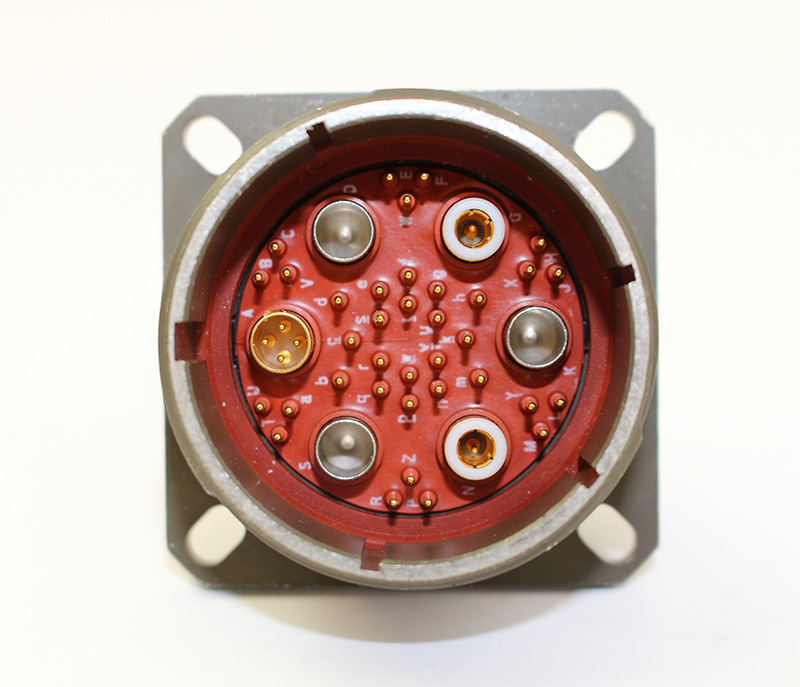
Amphenol Aerospace’s High-Speed Connectors are designed to support high-speed data distribution architecture throughout the system utilizing coaxial, twinax, triax, quadrax, Octonet, and differential twinax contacts. They’re manufactured with our MIL-DTL-38999 connectors.
Our high-speed catalog features a variety of high-speed contacts and capabilities, including Quadrax and Differential Twinax size 8 contacts form matched impedance differential pairs (100 or 150 ohm) for high-speed data transmission, while Octonet contacts incorporate four 100 ohm matched differential pairs within a single size 8 contact that supports 10G Ethernet applications and enhanced crosstalk performance in D38999 Series III connectors. For RF and microwave signal paths, coaxial contacts (sizes 4, 8, 12, and 16) and matched impedance variants are engineered for controlled VSWR and shielding. For the C-UAS system, this allows for clean signal transport, reliable high-speed pathways, and scalable sensor-to-processor connectivity.
High Power and Voltage
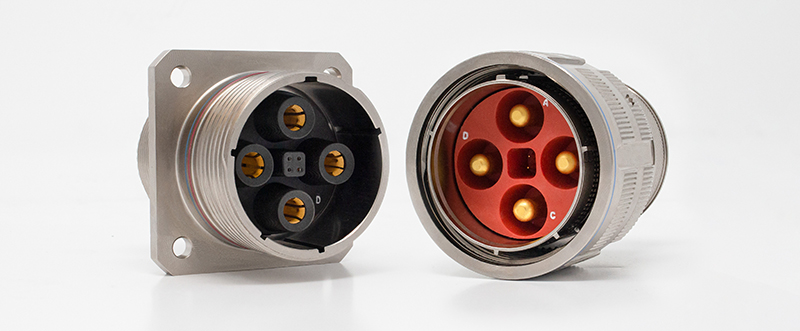
Amphenol Aerospace High Power and High Voltage Connectors are engineered to support demanding power distribution found within modern C-UAS platforms. The modern C-UAS suite likely features a variety of power-demanding applications that will require ruggedized interconnects capable of carrying elevated current while maintaining thermal stability and mechanical reliability.
Our high power and high voltage solutions are built around proven mil-specs such as our MIL-DTL-5015 High Power and 38999 Tri-Power connectors and incorporate advanced power contact technologies including RADSOK, Temper-Grip, and High Current Pin (HCP) contacts.
The High Power 5015 Matrix and High Power 5015 series deliver 40% and 40–50% increased current carrying capability, respectively, over standard 5015 connectors, with configurable contact terminations including crimp, threaded, solder, PCB, and busbar options. Technologies such as RADSOK provide low contact resistance and high mating cycle durability, while Temper-Grip contacts maintain current capability in high-temperature environments exceeding 200 °C (392 °F).