High Performance Busbars

Product High Performance Busbars Product High Performance Busbars

Contact:

Joshua Chicorelli
Product Manager
(607) 376-3947
jchicorell@amphenol-aao.com

Description:

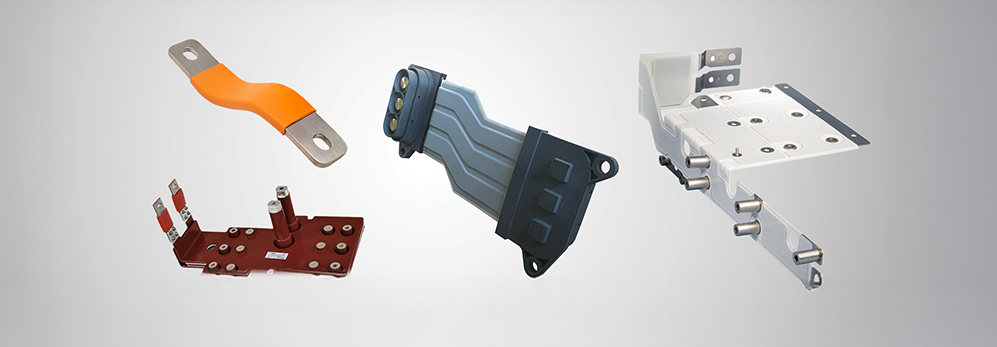
Amphenol Busbars are engineered for high current density, thermal efficiency, and harsh environments.

Amphenol Commercial Air Busbars offer a superior alternative to traditional wire and cable assemblies for power distribution in high-performance electrical systems. By providing a direct, low-impedance current path, busbars reduce voltage drop, improve electrical efficiency, and support higher current loads within a compact footprint. Their rigid or flexible constructions can be tailored to fit complex installation requirements, enabling optimized routing and seamless integration into equipment designs.

Busbars also improve thermal management by distributing heat more effectively than conventional cabling, helping to enhance overall system performance and longevity. Utilizing high-quality conductive materials and robust insulation systems, busbars deliver exceptional durability in environments subject to vibration, shock, moisture, and temperature extremes. The result is a lightweight, space-efficient, and highly reliable power distribution solution that reduces assembly complexity while supporting the growing power demands of modern aerospace and defense electrification applications.

Rigid, Flexible, and Hybrid Busbar Configurations

Configuration Best Fit
Rigid Busbar Power paths where the geometry is stable and the assembly can be fixed in place.
Flexible Busbar Systems with vibration, movement, or alignment challenges.
Braided Busbar High-current connections requiring flexibility in multiple axes.
Hybrid Busbar System Dense architectures where rigid and flexible sections need to work together.

Busbar Construction

Relevant physical properties of conductor materials used in busbar construction: 

Metal Density @ 20°C
(lb/in³)
CTE @ 20°C
(x10⁻⁶ m/m°C)
Thermal Coefficient  @ 20°C (W/m·K) Specification
Copper 110 0.323 17 388 ASTM B-152
QQ-C-576
Copper 101 0.323 17 383–391 ASTM B-152
QQ-C-576
Brass 260 0.308 19.9 120 ASTM B-36
QQ-B-613
Aluminum 6061-T651 0.098 23.6 154 ASTM-B236

Relevant electrical properties of conductor materials used in busbar construction: 

Metal Resistivity (ρ) @ 20°C
Ω·sq mil/ft
Conductivity % IACS @ 20°C Thermal Coefficient of Resistivity (α) @ 20°C
(10⁻²/°C)
Copper 110 8.1 101 0.393
Copper 101 8.1 101 0.393
Brass 260 290.06 28 0.098
Aluminum 6061-T651 13.35 62 0.423


Features & Benefits:

  • High Current Density with Low Resistance 
  • Thermal Performance and Heat Dissipation 
  • Aerospace and Defense-Grade Materials 
  • Custom Geometries for Tight Packaging and Mechanical Integration
  • Weight and Space Optimization 
  • Reliability in Harsh Environments 

Insulation is a critical element of busbar design because it provides electrical isolation between conductors and surrounding components, while protecting the busbar from environmental and mechanical conditions. In high-voltage and high-current applications, the insulation system must withstand electrical stresses while preventing short circuits, leakage current, arcing, and unintended contact. The right insulation approach also helps maintain dielectric performance and long-term reliability where temperature, vibration, moisture, contamination, and limited packaging space can all impact system performance.

Busbar Construction: Lamination

Insulation Material Choice:

Material Cost Colors Properties Temp. Index Notes
Mylar Low Clear White UL 94V-2 Coating 105°C External Insulation
Abrasion Resistant
Nomex Medium Off-White
Tan
UL 94V-0
Polyamide Paper
220°C Internal Insulation
High Dielectric Strength
FR1 Valox Medium Off-White UL 94V-0
UL 94V-0TMO
125°C Easy to Fabricate
High Dielectric
Kapton Very High Yellow Red UL 94V-0 Film 240°C High Dielectric
FR4/Phenolic Medium Tan Green UL 94V-0 125°C/
105°C
High Voltages
Edge Protection
Epoxy Embedding Medium Black White
Amber
UL 94V-0 150°C Edge Protection
Powder Coating Low Many UL 94V-0 125°C Complex Shapes, Holes
and Edges

Lamination Edge-Sealing

For laminated busbars, edge sealing is an important consideration because the exposed edges of the dielectric layers can provide a potential pathway for moisture, contamination, or dielectric degradation. Several approaches can be used depending on the application and environmental requirements.

Pinch Seal: The insulation layers are compressed or bonded together around the conductor perimeter to close the exposed laminate edge. This approach can provide a relatively thin, integrated edge treatment while maintaining the overall profile of the busbar.

Edge Fill: A compatible insulating material is applied along the exposed edge of the laminate to fill voids and create an additional environmental and dielectric barrier. Edge fill can be particularly useful for demanding environmental applications where additional protection is required.

Laminate Wrap: The dielectric material is extended around the edge of the conductor and wrapped onto the opposing surface. This provides additional insulation coverage and minimizes exposed laminate edges, although it can add manufacturing complexity and localized thickness.

Busbar Construction: Plating

Metal Conductivity Thermal Coefficient of Resistivity (α) @ 20°C
(10⁻²/°C)
Specification
Tin 13.6 0.42 ASTM B545
MIL-T-10727
Nickel 11.8 0.48 AMS 2403, AMS-QQ-N-290, QQ-N-290
Silver 105.8 0.38 ASTM B700
Solder Alloy 60/40 10 0.40 AMS-P-81728
MIL-P-81728


High Performance Busbars
Amphenol Busbars are engineered for high current density, thermal efficiency, and harsh environments.
Distributor?
Is FAI Required?
Have you ordered from us before?

Part Number
Min Qty
Max Qty
Target Price
Delivery Date
Add Part
* By clicking the Submit button, you agree to Amphenol’s Privacy Policy & Terms and Conditions.